Buying black pepper in bulk: FSSAI limits, bulk density, export registration, GST and quotes
How to buy whole and ground black pepper: the FSSAI standard for moisture, piperine, light berries and bulk density, lab checks, packing, the exporter registration, 5% GST and red flags.
7 min read
In this article
Black pepper sold as food in India must meet FSSAI's standard for black, white and green peppers, which sets limits on moisture, light berries, pinheads, foreign matter and mould, and minimums for piperine, volatile oil and bulk density. GST on pepper is 5% (Notification 9/2025-Central Tax (Rate) (opens in a new tab)). Buy against an approved sample and a lab report for each lot, and compare quotes per kilogram of cleaned pepper delivered. If you export, you also need the Spices Board's exporter registration.
Key facts
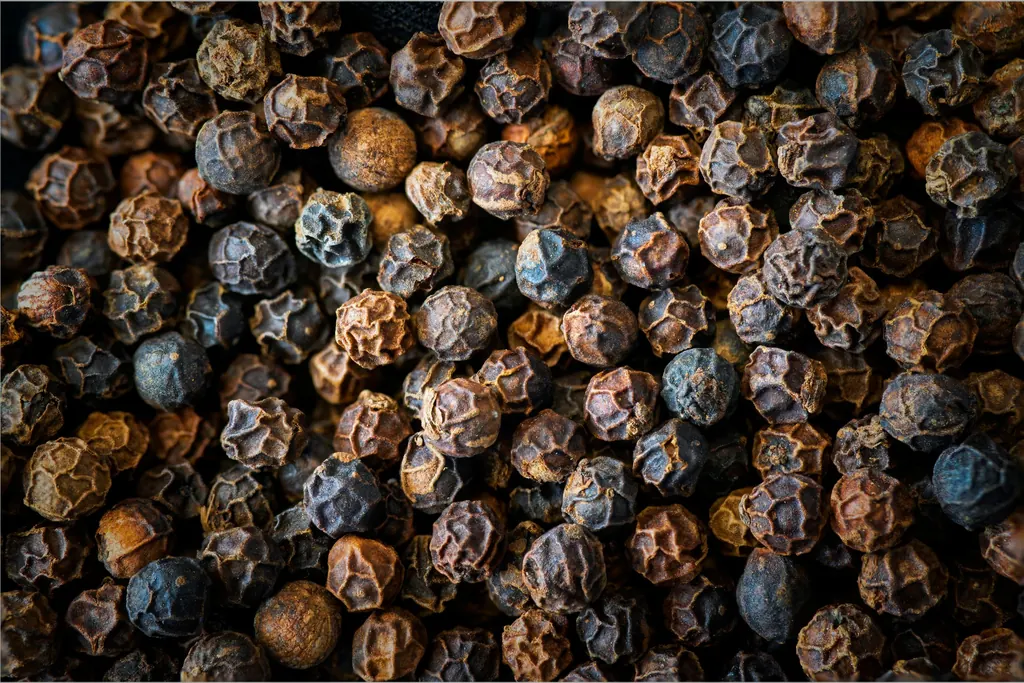
- FSSAI defines black pepper as the dried berries of Piper nigrum with unbroken, wrinkled pericarp, a minimum diameter of 2.0 mm, a brownish to blackish colour and a penetrating, pungent flavour, free from mouldy or rancid odours and added colours (FSSAI standards, regulation 2.9.15 (opens in a new tab)).
- Every food business must be registered with FSSAI or hold an FSSAI licence (FSSAI licensing and registration regulations, 2.1 (opens in a new tab)).
- For export or import of spices and spice products, the Spices Board's Certificate of Registration as Exporter of Spices (CRES) is mandatory (Spices Board FAQ (opens in a new tab)).
The FSSAI limits for whole black pepper
| Requirement | Limit |
|---|---|
| Moisture, % by mass | 13.0 maximum |
| Total ash, % on dry basis | 7.0 maximum |
| Acid-insoluble ash, % on dry basis | 1.5 maximum |
| Volatile oil, ml per 100 g on dry basis | 1.0 minimum |
| Non-volatile ether extract, % on dry basis | 6.0 minimum |
| Piperine, % on dry basis | 2.0 minimum |
| Bulk density, g per litre | 400 minimum |
| Light berries, % by mass | 10.0 maximum |
| Extraneous vegetable matter, % by mass | 2.0 maximum |
| Foreign matter, % by mass | 0.5 maximum |
| Mouldy berries, % by mass | 3.0 maximum |
| Insect-defiled berries, % by mass | 2.0 maximum |
| Pinheads, % by mass | 4.0 maximum |
Mammalian or other excreta is capped at 2.0 mg per kg. FSSAI explains that light berries are generally immature berries without a kernel, with an apparent density below 300 g per litre, and pinheads are small berries under 2 mm from unfertilised flowers, with less odour and flavour. Ground black pepper has its own limits, including moisture of 12.0% maximum, total ash of 6.0% maximum and crude fibre of 17.5% maximum (regulation 2.9.15 (opens in a new tab)).
These are the legal limits for food. Write any tighter limit you need, such as a higher bulk density or lower light berries, into your requirement.
What to put in your requirement
- Form: whole, cracked or ground, as FSSAI's standard names them.
- Quality: bulk density, light berries, moisture and any limits tighter than FSSAI's.
- Cleaning: machine-cleaned or sortexed, and whether you need it steam-sterilised.
- Packing: bag type and net weight, with an inner liner to keep moisture out, and labelling as the FSSAI labelling regulations require for packaged food.
- Documents: lab report for the lot, the seller's FSSAI licence or registration number, and for exports, the documents your buyer's country needs.
- Quantity and delivery: tonnes, lots and destination.
Checks on arrival
Compare each lot with the approved sample. A simple bulk density check is to fill a one-litre measure and weigh it; low weight means more light berries. Check moisture with a meter, look for mould, stones and stems, and send a sample to an accredited food lab for piperine, volatile oil and contaminants when the lot is large.
How to compare quotes on landed cost
- Same grade. Same bulk density, light berries, moisture and cleaning.
- Price per kilogram of clean pepper. Ask whether the price is for cleaned pepper and what weight loss to expect after cleaning.
- Packing. Bag type, liners and net weight.
- Freight to your warehouse or port, and insurance.
- GST at 5%, shown separately.
GST rate and HSN code
Pepper falls under HSN 0904. Notification 9/2025-Central Tax (Rate) lists "0904: pepper of the genus Piper; dried or crushed or ground fruits of the genus Capsicum or of the genus Pimenta" in its 2.5% schedule, which gives 5% with state tax (Notification 9/2025-Central Tax (Rate) (opens in a new tab)). An inter-state purchase carries 5% IGST (Notification 9/2025-Integrated Tax (Rate) (opens in a new tab)). Ask your CA about input tax credit for your use.
Questions to ask suppliers
- What bulk density, light berries and moisture can you commit to for this lot?
- Can you share a lab report for this lot, with piperine and volatile oil?
- Is the pepper machine-cleaned or sortexed, and what weight loss should I expect after cleaning?
- What is your FSSAI licence or registration number?
- How will it be packed, and with what liner?
- Is the rate delivered to my warehouse, with GST shown separately?
Red flags
- A low bulk density on your own one-litre check, or many hollow, light berries.
- Seeds that do not look like the approved sample. FSSAI's manual of methods includes tests for papaya seeds and for mineral oil in black pepper, so ask your lab to run them on a doubtful lot (FSSAI methods for spices, 10.023 and 10.024 (opens in a new tab)).
- Musty or mouldy smell, or visible mould.
- No FSSAI licence or registration number on the invoice or pack.
- A request to pay a personal bank account or UPI ID that does not match the supplier's GST-registered name.
How Indibaba can help
Tell Indibaba AI what you need, for example "black pepper whole, machine cleaned, bulk density 550 g per litre minimum, moisture 11% maximum, 5 tonnes in 25 kg bags with liners, lab report per lot, delivered to Kochi", or use the requirement form. Indibaba AI drafts the requirement and nothing goes to suppliers until you confirm it. It reaches suppliers listed under black pepper and the RFQ market, where other sellers can quote. Indibaba is new, so some categories still have few suppliers. Suppliers that Indibaba has checked carry the Indibaba Certified badge; others show "Not checked yet".
Rules as of 18 November 2026. This article explains public rules in plain English. For a decision about your business, check the official notification or ask your CA.
Frequently asked questions
What is the FSSAI standard for black pepper?
Regulation 2.9.15 of the food product standards. For whole black pepper it allows at most 13% moisture and 10% light berries, and requires at least 2% piperine and a bulk density of at least 400 g per litre, among other limits.
What is the GST rate on black pepper?
5%. Pepper under HSN 0904 is in the 2.5% central tax schedule of Notification 9/2025-Central Tax (Rate), so a sale within a state carries 2.5% CGST and 2.5% SGST.
What are light berries in pepper?
Generally immature berries without a kernel, with an apparent density below 300 g per litre. FSSAI allows up to 10% in whole black pepper.
Do I need registration to export black pepper?
Yes. The Spices Board says its Certificate of Registration as Exporter of Spices is mandatory for exporting or importing spices and spice products.
Sources
We checked the facts in this article against these sources on 18 November 2026.
- Food product standards, chapter 2.9: salt, spices, condiments and related products (version of 1 August 2025) (opens in a new tab), Food Safety and Standards Authority of India. Read on 18 November 2026.
- Food Safety and Standards (Licensing and Registration of Food Businesses) Regulations, 2011 (opens in a new tab), FSSAI. Read on 18 November 2026.
- Manual of methods of analysis of foods: spices and herbs (methods 10.023 and 10.024) (opens in a new tab), FSSAI, 22 June 2021. Read on 18 November 2026.
- Frequently asked questions: CRES (opens in a new tab), Spices Board, Ministry of Commerce and Industry. Read on 18 November 2026.
- Notification No. 9/2025-Central Tax (Rate) (opens in a new tab), Central Board of Indirect Taxes and Customs (CBIC), 17 September 2025, as amended up to Notification No. 02/2026-Central Tax (Rate). Read on 18 November 2026.
- Notification No. 9/2025-Integrated Tax (Rate) (opens in a new tab), CBIC, 17 September 2025. Read on 18 November 2026.