Buying MCBs and RCCBs: B, C and D curves, ISI mark, GST and quotes
How to buy miniature circuit breakers and RCCBs for a building or for resale: tripping curves, ratings and breaking capacity under IS/IEC 60898-1, the ISI rule, 18% GST and red flags.
7 min read
In this article
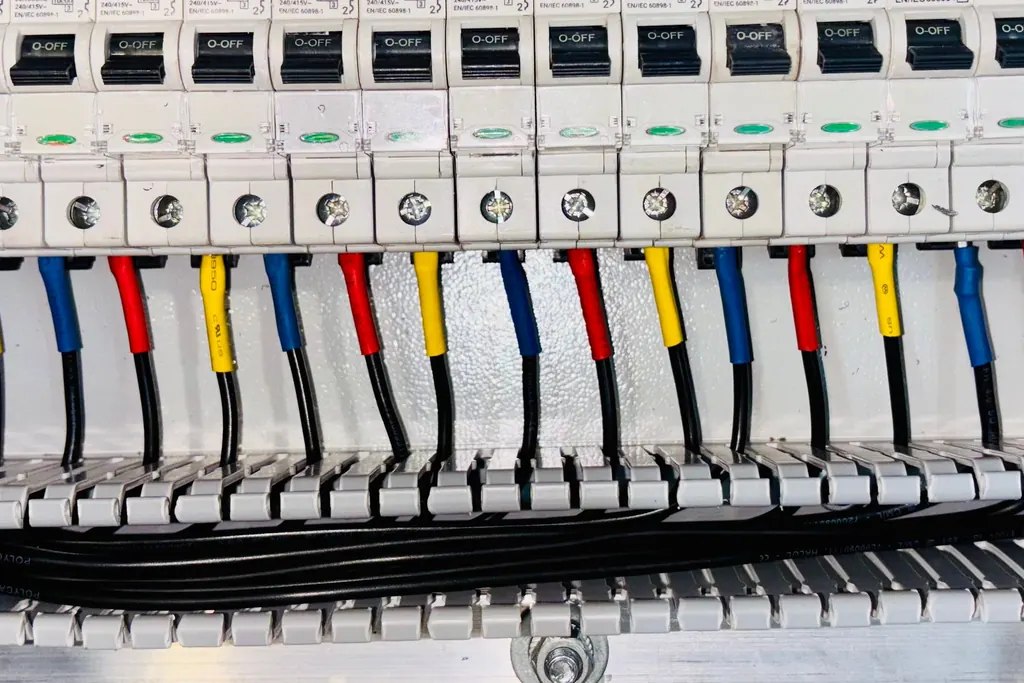
Miniature circuit breakers (MCBs) for homes, shops and offices are made to IS/IEC 60898-1, and residual current circuit breakers (RCCBs and RCBOs) to IS 12640. Both are under BIS's compulsory certification, so they must carry the ISI mark. GST on these switching and protective devices is 18% (Notification 9/2025-Central Tax (Rate) (opens in a new tab)). Your electrical designer chooses the curve, rating and breaking capacity; your purchase order should repeat them exactly.
Key facts
- RCCBs (IS 12640 Part 1), RCBOs (IS 12640 Part 2) and circuit breakers for household and similar installations (IS 8828, since revised as IS/IEC 60898) are listed under the Electrical Wires, Cables, Appliances and Protection Devices and Accessories (Quality Control) Order, 2003 (BIS Scheme-I list (opens in a new tab)).
- MCBs come in three instantaneous tripping types: B trips above 3 up to 5 times rated current, C above 5 up to 10 times, and D above 10 up to 20 times (IS/IEC 60898-1:2002, Table 2 (opens in a new tab)).
- Preferred rated currents run from 6 A to 125 A, and standard short-circuit capacities include 3000 A, 4500 A, 6000 A and 10 000 A (clause 5.3 (opens in a new tab)).
- The current BIS licence standard for MCBs is IS/IEC 60898-1:2015, and for RCCBs IS 12640 (Part 1):2024 (BIS product manuals list (opens in a new tab)).
Curve, rating, breaking capacity and poles
Tripping type (curve). The letter tells you how much surge current the breaker tolerates before it trips instantly. Type B suits circuits with little inrush current; C and D tolerate more inrush, for example from motors or transformers. The standard itself notes that the choice may depend on installation rules (IS/IEC 60898-1, clause 4.5 (opens in a new tab)).
Rated current. Marked together with the curve letter, for example "B 16" or "C 32".
Rated short-circuit capacity. The largest fault current the breaker can safely interrupt, marked in amperes. It must be at least the prospective fault current at the point of installation, which your designer calculates.
Poles. Single pole, single pole and neutral, double pole, triple pole or four pole, depending on the circuit.
For RCCBs and RCBOs, also specify the rated residual operating current, often called sensitivity, and the number of poles.
What the marking must show
IS/IEC 60898-1 asks for each breaker to be durably marked with the maker's name or trade mark, the type designation or catalogue number, rated voltage, the rated current preceded by the curve letter, the rated short-circuit capacity in amperes and, where needed, a wiring diagram. The curve and rating marking must be visible once the breaker is installed (clause 6 (opens in a new tab)). BIS adds that each certified breaker must carry a code that traces it to the date and control unit of manufacture (BIS product manual for IS/IEC 60898-1 (opens in a new tab)).
Check the CM/L licence number on BIS's Manak Online portal or the BIS Care app, and make sure the licence covers MCBs under IS/IEC 60898-1, or RCCBs under IS 12640, in the maker's name.
How to compare quotes on landed cost
- Like for like. Curve, rating, poles and breaking capacity must match. A 6000 A breaker and a 10 000 A breaker are different products.
- Brand and range. A maker may sell more than one range; compare catalogue numbers, not just descriptions.
- Packing quantity. Breakers are packed in boxes of a fixed count; ask whether you must buy full boxes.
- Freight to your pincode and GST at 18%, shown separately.
- Warranty and replacement for units that fail on commissioning.
GST rate and HSN code
MCBs, RCCBs, isolators and similar devices for voltages up to 1,000 volts fall under HSN 8536, and distribution boards and panels under 8537. Notification 9/2025-Central Tax (Rate) lists both headings in its 9% schedule, which gives 18% with state tax (Notification 9/2025-Central Tax (Rate) (opens in a new tab)). An inter-state purchase carries 18% IGST (Notification 9/2025-Integrated Tax (Rate) (opens in a new tab)).
Questions to ask suppliers
- What is the CM/L licence number, and does it cover this product and standard?
- What curve, rated current, poles and short-circuit capacity does each catalogue number have?
- For RCCBs, what is the rated residual operating current?
- Are you the maker, an authorised distributor or a trader? Can you show the authorisation?
- What is the warranty, and how are failed units replaced?
- Is the rate delivered to my pincode, with GST shown separately?
Red flags
- No ISI mark or licence number on the breaker or its box.
- A curve letter or capacity missing from the front of the breaker.
- A licence number that shows a different maker or product when you check it.
- Breakers that feel light or loose, or have misaligned printing, in a box of a well-known brand. Ask the brand's authorised distributor to confirm the batch.
- A price far below the brand's usual distributor rates with no explanation.
- A request to pay a personal bank account or UPI ID that does not match the supplier's GST-registered name.
How Indibaba can help
Tell Indibaba AI what you need, for example "MCB C 32 double pole 10 kA, 60 pieces, and RCCB 63 A four pole 30 mA, 10 pieces, delivered to Kochi", or use the requirement form. Indibaba AI drafts the requirement and nothing goes to suppliers until you confirm it. It reaches suppliers listed under MCBs and switchgear and the RFQ market, where other sellers can quote. Indibaba is new, so some categories still have few suppliers. Suppliers that Indibaba has checked carry the Indibaba Certified badge; others show "Not checked yet".
Rules as of 17 November 2026. This article explains public rules in plain English. For a decision about your business, check the official notification or ask your CA.
Frequently asked questions
Is the ISI mark compulsory for MCBs?
Yes. Circuit breakers for household and similar installations, RCCBs and RCBOs are listed under the Electrical Wires, Cables, Appliances and Protection Devices and Accessories (Quality Control) Order, 2003. Each must carry the Standard Mark under a BIS licence.
What is the difference between B, C and D curve MCBs?
They trip instantly at different multiples of rated current: type B above 3 up to 5 times, type C above 5 up to 10 times, and type D above 10 up to 20 times. C and D tolerate more inrush current, for example from motors.
What is the GST rate on MCBs?
18%. Electrical apparatus for switching or protecting circuits up to 1,000 volts (HSN 8536) is in the 9% central tax schedule of Notification 9/2025-Central Tax (Rate), so a sale within a state carries 9% CGST and 9% SGST.
What does 6 kA or 10 kA on an MCB mean?
It is the rated short-circuit capacity: the largest fault current the breaker is rated to interrupt, marked on the breaker in amperes. It must be at least the prospective fault current where it is installed.
Sources
We checked the facts in this article against these sources on 17 November 2026.
- Products under compulsory certification, Scheme-I (ISI Mark Scheme) (opens in a new tab), Bureau of Indian Standards, last updated 21 October 2026. Read on 17 November 2026.
- IS/IEC 60898-1:2002 Circuit-breakers for overcurrent protection for household and similar installations, Part 1, public copy (opens in a new tab), Bureau of Indian Standards (copy on Internet Archive); the current edition is 2015. Read on 17 November 2026.
- Product manual for IS/IEC 60898-1:2015 (opens in a new tab), Bureau of Indian Standards, March 2019. Read on 17 November 2026.
- Product manuals list (IS/IEC 60898-1, IS 12640) (opens in a new tab), Bureau of Indian Standards. Read on 17 November 2026.
- Notification No. 9/2025-Central Tax (Rate) (opens in a new tab), Central Board of Indirect Taxes and Customs (CBIC), 17 September 2025. Read on 17 November 2026.
- Notification No. 9/2025-Integrated Tax (Rate) (opens in a new tab), CBIC, 17 September 2025. Read on 17 November 2026.