CNC lathe or VMC: which machine for which job
CNC lathe or vertical machining centre (VMC): what each machine makes, the specs to compare, and questions to ask before you buy.
8 min read
In this article
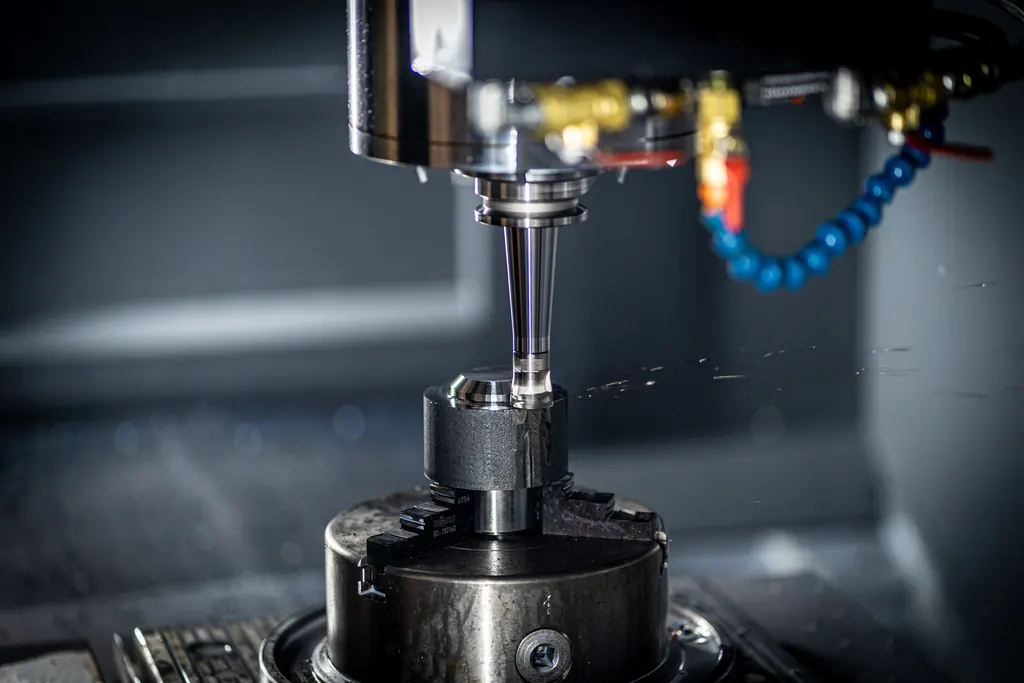
A CNC lathe, also called a turning centre, spins the workpiece against a stationary cutting tool and makes round parts such as shafts, pins and bushes. A vertical machining centre (VMC) spins the tool in a vertical spindle and cuts a workpiece held on a table. VMCs make flat and box-shaped parts, pockets, holes and moulds (Ace Micromatic (opens in a new tab)).
Key facts
- On a CNC turning machine the workpiece rotates and the tool stays still. Typical work includes OD and ID turning, facing, grooving, threading, drilling and boring (Ace Micromatic, January 2026 (opens in a new tab)).
- A VMC has a vertically oriented spindle and is used for milling, drilling and tapping. Typical uses include dies and moulds, brackets and housings (Ace Micromatic, January 2026 (opens in a new tab)).
- Turn-mill centres add C-axis and Y-axis capability, so one machine can turn, drill, tap and mill without re-fixturing (Ace Micromatic turning range (opens in a new tab)).
- ISO 230-2:2014 sets methods for testing the positioning accuracy and repeatability of numerically controlled axes, for acceptance tests and periodic checks among other uses (ISO (opens in a new tab)).
What is a CNC lathe or turning centre?
A CNC lathe holds the workpiece in a chuck or between centres and rotates it. A tool mounted on a turret moves along two axes: X (across the part, which sets the diameter) and Z (along the part, which sets the length). Ace Micromatic, an Indian maker, uses "CNC lathe" and "CNC turning centre" for the same family of machines (Ace Micromatic (opens in a new tab)).
The same maker groups its turning range into 2-axis horizontal lathes, vertical lathes for wide, short parts such as discs and rings, turn-mill centres, twin-spindle machines and sliding-head (Swiss-type) automats for small, precise parts (Ace Micromatic turning range (opens in a new tab)).
What is a vertical machining centre (VMC)?
A VMC is a CNC milling machine with a vertical spindle. The cutter rotates and moves relative to the workpiece along X, Y and Z, and an automatic tool changer (ATC) swaps tools during a program (Ace Micromatic (opens in a new tab)). The same source says VMCs suit flat parts, cavity milling and surface machining. It contrasts them with horizontal machining centres (HMCs), whose horizontal spindle helps with multi-face machining and chip removal.
Which parts suit each machine?
| If the part is mostly... | Usually made on | Examples |
|---|---|---|
| Round and symmetric about one axis | CNC lathe / turning centre | Shafts, pins, bushes, sleeves, hubs |
| Flat or box-shaped, with pockets, slots or hole patterns | VMC | Brackets, housings, fixtures, die and mould parts |
| Round, but with flats, cross-holes or slots | Lathe then VMC, or a turn-mill centre | Depends on the drawing |
The example parts come from the maker's application lists (Ace Micromatic (opens in a new tab)). Real parts often need both machines. Count the operations on your drawing before deciding.
Which specs should you compare on a CNC lathe?
The examples below come from two published Indian spec sheets: a compact 2-axis lathe (J 300 LM (opens in a new tab)) and a longer flat-bed lathe (SimpleTurn 50125 XL (opens in a new tab)). They show what each field means. They are not recommendations.
| Spec | What it tells you | Example: J 300 LM | Example: SimpleTurn 50125 XL |
|---|---|---|---|
| Swing over bed | Largest diameter that clears the bed | 500 mm | 500 mm |
| Maximum turning diameter | Largest diameter the tools can actually cut | 320 mm | 280 mm (205 mm with the 6-station turret) |
| Maximum turning length | Longest length that can be turned | 300 mm | 1120 mm (1020 mm with the 6-station turret) |
| Distance between centres | Space for long parts supported by the tailstock | not listed | 1250 mm |
| Spindle nose | Chuck mounting standard | A2-5 | A2-6 |
| Bore through spindle / max. bar capacity | Largest bar that passes through the spindle | 52.5 mm / 42 mm | 63 mm / 42 mm |
| Standard chuck size | Work-holding range | 165 mm (200 mm optional) | on quotation |
| Maximum spindle speed | Upper speed limit | 4000 rpm | 2000 rpm |
| Turret stations | Tools available without a manual change | 8 | 4 or 6 |
Also compare spindle motor power, guideway type (linear motion, box, or V-and-flat), tailstock taper and overall size and weight. Both sheets list these.
Which specs should you compare on a VMC?
This example is a published Indian VMC spec sheet (850V (opens in a new tab)):
| Spec | What it tells you | Example: 850V |
|---|---|---|
| X / Y / Z travel | Size of the working envelope | 800 / 510 / 500 mm |
| Table size and maximum table load | Largest fixture and job weight | 1000 × 510 mm, 400 kg |
| Spindle face to table | Space for vice, fixture, job and tool | 100 to 600 mm |
| Spindle taper / tool shank | Which tool holders fit | BT-40 |
| Spindle speed | Speed range of the spindle | 60 to 6000 rpm standard, up to 15000 rpm option |
| ATC capacity | Tools held ready in the magazine | 24 standard, 30 optional |
| Maximum tool diameter, length and weight | Limits on large cutters | 80 mm, 250 mm, 8 kg |
| Positioning accuracy / repeatability | Axis precision, with the standard used | 0.010 mm / ±0.003 mm, stated "as per ISO 230-2" |
| CNC system | Control make | Fanuc |
How should you read accuracy figures?
ISO 230-2:2014 sets out how to test and evaluate the accuracy and repeatability of positioning of numerically controlled axes. It measures each axis directly on the machine, with repeated measurements at each position (ISO (opens in a new tab)). The VMC sheet above states its figures against this standard. The two lathe sheets above do not state accuracy figures.
Practical points:
- Ask which standard and which edition a quoted accuracy figure follows. Figures measured by different methods cannot be compared directly.
- Ask for the inspection or test report for the machine you will receive, not only the brochure figure.
- Positioning accuracy describes the machine's axes. It is not the same as the tolerance on a finished part, so agree part tolerances with your supplier separately.
Which control system should you choose?
Most makers offer more than one controller. The J 300 LM, for example, is offered with Fanuc, Siemens or Delta controls (J 300 LM (opens in a new tab)). Pick one that your programmers and maintenance staff know, or that your CAM post-processor supports. Ask who provides controller service near your plant.
Questions to ask before you buy
- Which of my drawings can this machine finish in one setup, and which need a second machine?
- Do the travels, swing or turning length leave margin for my largest part plus its fixture?
- Which spindle nose or taper is it, and will my existing chucks or tool holders fit?
- What accuracy standard are the figures measured to, and can I see the test report?
- What is included in the quote: chuck, tailstock, coolant, chip conveyor, ATC size, installation and training?
- Where is the nearest service engineer, and which spares are kept in stock?
For the wider buying process, see our CNC machines buying guide. If you are writing a request for quotation, our RFQ template lists what to include.
How Indibaba can help
You can post a requirement for a CNC lathe or VMC with the specs above, your city and your needed-by date. Supplier profiles on Indibaba show "Indibaba Certified" when our team has checked the supplier's documents, or "Not checked yet". You can browse CNC machine tools, industrial machinery or, if you would rather outsource the parts, CNC machining services.
Frequently asked questions
What is the difference between CNC and VMC?
CNC means computer numerical control, the way the machine is driven, so both CNC lathes and VMCs are CNC machines. A CNC lathe rotates the workpiece against a stationary tool, while a VMC rotates the cutting tool in a vertical spindle over a moving table.
Is a CNC turning centre the same as a CNC lathe?
In everyday use, yes. Makers such as Ace Micromatic use both names for machines that turn rotating workpieces. Turn-mill centres are a step further and add driven tools for milling, drilling and tapping in the same setup.
What does BT40 mean on a VMC?
BT40 is the type of tool-holder shank the spindle accepts. Spec sheets list it as the spindle's tool shank type, and it decides which tool holders you can use.
What do positioning accuracy and repeatability mean on a CNC spec sheet?
They describe how closely an axis reaches a commanded position and how consistently it returns there. ISO 230-2 is one international method for measuring them, so ask which standard a quoted figure follows.
Sources
We checked the facts in this article against these sources, last on 16 November 2026.
- Types of CNC Machines Explained (Turning, Milling, Grinding, etc.) (opens in a new tab), Ace Micromatic Group, 22 January 2026. Read on 16 November 2026.
- What is CNC Turning: CNC turning machine range (opens in a new tab), Ace Micromatic Group. Read on 16 November 2026.
- J 300 LM key specifications (opens in a new tab), Ace Micromatic Group. Read on 16 November 2026.
- SimpleTurn 50125 XL key specifications (opens in a new tab), Ace Micromatic Group. Read on 16 November 2026.
- 850V key specifications (opens in a new tab), Ace Micromatic Group. Read on 16 November 2026.
- ISO 230-2:2014 Test code for machine tools - Part 2: Determination of accuracy and repeatability of positioning of numerically controlled axes (opens in a new tab), International Organization for Standardization, May 2014. Read on 16 November 2026.